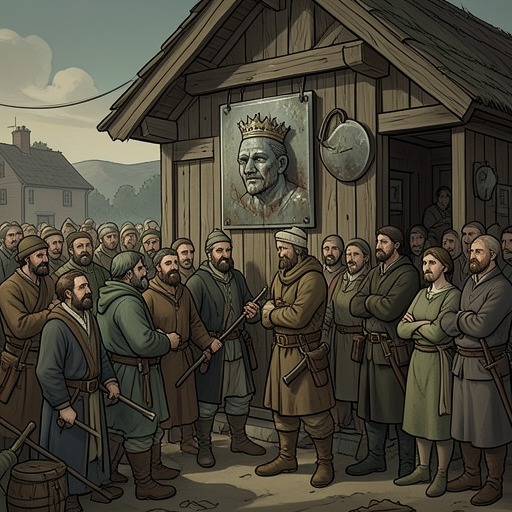
The Forest Cantons’ Traditional Duties to the Empire and Self-Government
William TellThe Forest Cantons’ Traditional Duties to the Empire and Self-Government is the political and legal principle that lets the Swiss communities distinguish their acknowledged obligations to the emperor from the coercive rule of the governors. They claim a longstanding freedom to govern themselves under local laws and customs, while accepting imperial protection, a superior judge, and a duty to serve in war. This is not an argument against every form of authority: it is an argument about where authority comes from, what it permits, and where its limits lie.
Local Freedom and Imperial Protection
The communities describe themselves as free from the beginning, unlike people born into hereditary villein service. They say they never bowed to princes, but freely sought the empire’s protection—and that this protection was freely granted. Stauffacher reinforces the distinction by acknowledging that even the freest communities have a feudal lord and need a supreme judge to hear appeals in disputes. Freedom, in this account, does not mean the absence of every superior power; it means that subjection to a superior is limited and does not erase local self-rule.
The appeal to Frederick’s charter gives this political memory a documentary foundation. Rosselmann says that the freely sought and freely granted relationship is set down there. The charter therefore serves in the debate not as evidence that the communities have no obligations, but as evidence of the character of those obligations: protection and recognized standing, rather than unrestricted princely command. The play presents the communities’ claim as an established arrangement they can invoke against a later abuse of power.
The Terms of the Relationship
The communities’ account assigns the emperor a real, if bounded, place in their political order. They owe him the honor due to a superior ruler and, like other free people of his realm, agree to aid him with their swords in war. Their stated duty is to guard the empire that guards them. Military service is thus framed as reciprocal: the communities defend an authority that, in turn, protects them. The obligation does not authorize every official claiming to act in the emperor’s name to command them at will.
Their account of jurisdiction makes that limit concrete. At home, they say, they governed themselves peacefully according to their own laws and ancient usages, even when they marched to Italy to help place the imperial crown on the emperor. The emperor’s right in their territories is described as adjudicating the penalty of death; he therefore appointed a powerful noble as his delegate. That delegate was called in when judgment had to be passed and was expected to pronounce his decree openly, clearly, and without fearing anyone’s hatred. The stated procedure joins delegated authority to public judgment: it does not describe a governor’s private will as sufficient legal warrant.
Resistance Within the Claimed Order
This understanding shapes the proposed response to oppression. When the question turns to how to shake off the hated thralldom and preserve ancient rights, Walter Furst answers with a limit: they will do what necessity requires, but nothing further. He proposes driving out the tyrants and their agents and razing their towering strongholds. The stated aim is not to discard the imperial relationship that the communities have just defended, but to end the rule they regard as exceeding its proper bounds. Their resistance is consequently presented as the defense of inherited rights and self-government, not as a denial that any superior authority can exist.
The argument remains tied to collective action. The bond names the men of the Dale of Uri, the Community of Schwyz, and the men of the mountains of Unterwalden, placing the communities’ claim in a shared undertaking rather than in an individual privilege. Elsewhere, Rosselmann calls for a ring to be formed and the swords of power planted in the ground. That staged gesture gives the political argument a visible form: the assembled community stands together, while the weapons that may defend its rights become part of a common pledge.
Public Symbols and Political Memory
The conflict over the governor’s cap shows how power can be asserted through public ritual as well as through law. A crier announces in the emperor’s name that the cap will be set on a lofty pole in Altdorf’s marketplace, making the required display visible to the townspeople. The command associates the governor’s authority with an object before which the public is expected to perform deference. Its force lies not only in what the cap represents, but in the compelled gesture of recognition.
Later, the cap returns on a pole amid a crowd, but its meaning has changed. When someone urges that it be burned, Walter Furst argues instead that it should be preserved: once an instrument of despots, it can now stand as a lasting symbol of freedom. The reversal condenses the play’s distinction between authority and tyranny. The same object that once organized forced submission can be kept as evidence of a defeated claim to obedience, its public display now recalling the community’s liberation rather than demanding its deference.